
Between Station Crowds and Quiet Backstreets in Shibuya and Kita-Shinagawa, Tokyo: Common Pitfalls for Groups of Mixed Ages and Energy Levels, and How to Avoid Them
Between Station Crowds and Quiet Backstreets in Shibuya and Kita-Shinagawa, Tokyo: Common Pitfalls for Groups of Mixed Ages and Energy Levels, and How to Avoid Them
The pedestrian signal in front of the Hachiko statue at Shibuya Station turns green. People start walking from every direction at once, and within seconds the intersection is full. It's almost strange that nobody bumps into anyone.
Still in Shibuya, walk a little away from the station toward Maruyamacho and the noise suddenly drops. There are fewer signs, and the people passing by walk at a different pace. Stop partway up a hill and look back, and the crowds you just left feel far away.
I think much of what makes Tokyo interesting is this contrast. But when you travel with companions of different ages and energy levels, the contrast can trip you up as easily as it delights you. Everyone burns through their energy around the busy station, and by the time you reach the quiet backstreets, nobody wants to walk anymore. It happens on a lot of trips.
This article uses the areas around Street Kart's Shibuya, Shibuya Annex, and Shinagawa locations as examples. It covers where groups tend to run into trouble when moving between station areas and backstreets, and how to avoid it.
Why does the same city wear you out so differently near stations and in backstreets?
Start by comparing the stations. Shibuya Station is served by JR, Tokyo Metro, Tokyu, and the Keio Inokashira Line. Shinsen Station, about a 5-minute walk from the Shibuya location, is served only by the Keio Inokashira Line. Shinagawa follows the same pattern. Shinagawa Station is a terminal for the Shinkansen, JR, and Keikyu, while Kita-Shinagawa Station, about a 3-minute walk from the Shinagawa location, is a small station on the Keikyu Main Line.
With that big a difference in the number of lines, the number of people moving through the ticket gates differs too. At a large station, getting from the gates to street level can mean stairs, long passageways, and constantly reading the flow of people around you. That alone is tiring. Younger companions may find it exciting. For someone with bad knees or someone who dislikes crowds, though, that's where the exhaustion starts.
When you arrive in Tokyo, it's tempting to treat the buzz around the stations as the whole city. That isn't wrong. But once you know that crowds and quiet will alternate throughout the day, you plan differently. After a crowded place, go somewhere quiet to catch your breath. Build that order into the plan from the start, and you will likely see far fewer moments where someone in the group hits their limit halfway through the day.
In American cities, the change from the center to the surrounding areas is often more gradual. In Tokyo, a few minutes' walk from a station can change the scenery completely. Visitors from far away are often surprised by how quickly it happens.
Pitfall 1: Assuming everyone will do the same things
This is the first problem for groups with a wide range of ages. Everyone gets excited about going go-karting together because "we came all the way to Tokyo," and only at the booking stage does it turn out that someone doesn't meet the participation requirements. It can happen.
To drive a street kart, you need to meet requirements such as having a driver's license and being old enough. Exactly what's required, and which documents are accepted, depends on the country that issued the license and the type of license, so I won't make any definitive claims here. Before your trip, please check the Street Kart official website for everyone who plans to drive. Judging from only some of the requirements is risky. If anything is unclear, contact them before you book.
The point I want to make is that the trip doesn't fall apart if not everyone can drive. In fact, planning from the start to split into two groups means nobody has to push themselves.
The karts are single-seaters, and passengers aren't allowed. Tours are led by a guide along a fixed route that differs by location. So while the drivers are out on the tour, everyone else spends that time near the shop. This is where options in the backstreets, rather than around the station, really help.
From the Shinagawa location, Shinagawa Shrine is about a 5-minute walk away, and the old-fashioned Kita-Shinagawa Shopping Street is nearby. From the Shibuya location, Starbucks Shibuya Tsutaya is about an 8-minute walk away, where you can sit down and wait. Don't let the non-drivers' time turn into "time spent waiting." How the day feels for everyone often depends on that.
Tour lengths vary by location and plan. When planning for those who will be waiting, check the latest information on the official website first.
Pitfall 2: Choosing a huge terminal station as your meeting point
Groups often pick Hachiko in Shibuya or the central gate at Shinagawa Station as a meeting point because they're easy to find. These aren't great choices for a group with a wide range of ages. Where crowds move quickly, even standing still makes you worry about the people around you. It's hard to make a phone call over the noise. And if someone goes out through the wrong ticket gate, there's no telling how long it will take to find each other.
The fix is simple: use the small station closest to the shop. The Shibuya and Shibuya Annex locations are practically in the same place. Both are about a 10-minute walk from Shibuya Station, or about 5 minutes from Shinsen Station. The crowd you find at street level is very different from Shibuya Station.
The Shinagawa location is about a 10-minute walk from Shinagawa Station, about 3 minutes from Kita-Shinagawa Station, and about 7 minutes from Shimbamba Station. If you arrive at Shinagawa by Shinkansen, you can also transfer to the Keikyu Line and get off at Kita-Shinagawa. Walk out of the gates and the tall station buildings gradually give way to rows of low rooftops.
One more thing. Some travelers think about driving a rental car or taking a taxi straight to the shop. If you're thinking of a rental car, be careful: the shops have no parking, and the company officially recommends using public transportation. When choosing between the train and a taxi, consider whether transfers and the walk from the station would be hard on anyone in your group.
When you look up directions on Google Maps, set the shop name as the destination and switch the last leg to "walking" to check it. Large stations have many exits, and taking the wrong one can change how far you have to walk.
Pitfall 3: Assuming quiet places will be easy
Turning off into the backstreets to avoid the crowds will make things easier. That's half true. Quiet places have pitfalls of their own.
Shinagawa Shrine is a good example. It's close, about a 5-minute walk from the Shinagawa location, and the row of torii gates at the top of the stone steps is hard to forget. The grounds also have a Fujizuka, a miniature Mount Fuji you can climb. But both the stone steps and the Fujizuka can be hard on anyone with weak legs or back. Don't assume everyone has to go to the top. Some can climb while others wait at the bottom. Decide that at the start, and nobody has to push themselves.
Also watch your sense of distance. From the Shibuya location, Meiji Jingu and Yoyogi Park are about a 20-minute walk. From the Shinagawa location, Tennozu Isle and Sengakuji Temple are also about 20 minutes on foot. They look close on a map. But a round trip is 40 minutes, and for some people that alone can take up most of the day's energy.
Personally, I think it works best to visit just one place before or after the tour, and keep it within a 10-minute walk of the shop. From the Shinagawa location, that could be Shinagawa Shrine or Honsenji Temple, about a 10-minute walk away. Honsenji is one of the Six Jizo of Edo, and it has a large bonsho (temple bell) designated as a Tangible Cultural Property of Tokyo. From the Shibuya location, grabbing a bite at Dogenzaka Ramen Yokocho, about an 8-minute walk away, is a good option too. Save the more distant sights for a day when everyone has energy to spare.
The quiet of the backstreets is part of the daily lives of the people who live there, and that's part of what makes it interesting. On shopping streets and residential roads, talking loudly or blocking the path to take photos stands out. Step to the side of the street when you stop. Pause before pointing a camera at someone's home or storefront. If you need help, saying "sumimasen" (excuse me) will get you most of the way. Every time I walk these streets, I'm still struck by how quietly people talk.
Pitfall 4: Booking on a whim for the weekend and showing up with no plan for language
Partway through the trip, someone suggests, "Why don't we go karting tomorrow, on Saturday?" I understand the impulse. But weekends tend to fill up, so if you know which day you want to drive, I recommend booking early. For groups with a wide range of ages, just finding a day when everyone feels up to it takes some coordinating. Keep two or three possible dates in mind, so you won't panic if your first choice is taken.
Bookings are accepted via Facebook, LINE, and email (booking@streetkart.com). If you contact them by email, include up front the number of people, how many will drive and how many won't, and your preferred location and date. That keeps the back-and-forth short.
A word about language. Guidance on the day of the tour is generally in English. Whether you can get guidance in Japanese or other languages depends on the staff that day, so it isn't guaranteed. If anyone in your group isn't comfortable with English, have other members listen to the pre-departure briefing with them so they can fill in any gaps afterward. The website is available in 22 languages, so it's a good place to check participation requirements calmly in advance.
Also think about weather and season once before you book. Tokyo's heat and cold vary a lot by season, and even at the same time of day, how it feels can change completely from one day to the next. Check the official website for how weather affects tours, and look at the forecast for the day. For companions who will be waiting, having one indoor option ready makes things easier.
A little about Street Kart itself
Here's a bit about the street kart experience itself.
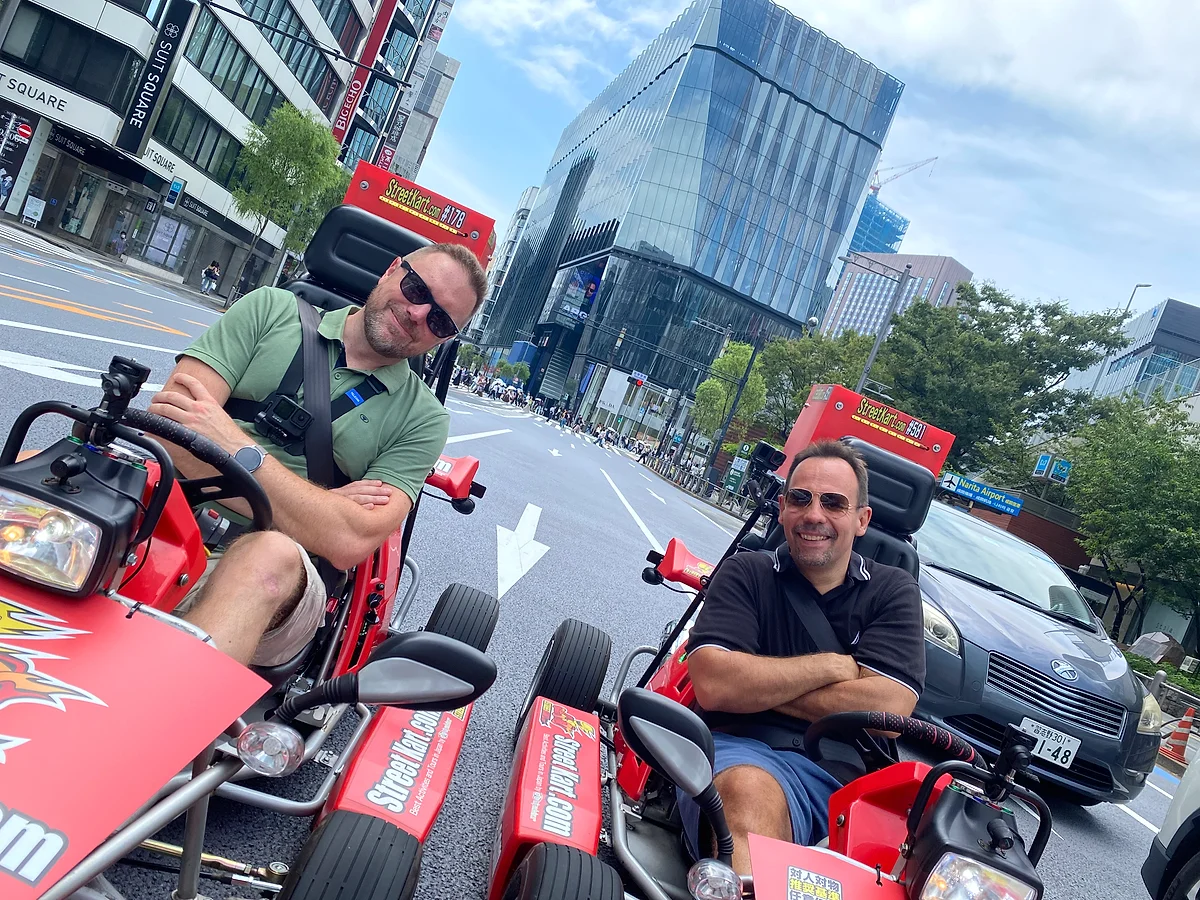
On the tour, a trained guide drives at the front. Each location has a fixed route, and participants follow behind. When you aren't used to Tokyo's roads, just seeing someone ahead of you takes some of the tension away.
From my own experience driving one, you feel close to the city. You look up at the height of the buildings and the width of the intersections from an angle you don't usually see. The wind and street sounds reach you directly, so you feel the difference between the noise around the stations and the quiet of the backstreets with your body, not just your head.
Highlights listed for the Shibuya and Shibuya Annex routes include the Shibuya Scramble Crossing, Takeshita Street in Harajuku, and zelkova-lined Omotesando. Highlights listed for the Shinagawa routes include views of the Rainbow Bridge and Tokyo Tower, and the Takanawa and Shibaura/Tamachi areas. Please check the official website to see which places each tour passes.
As for numbers, as of November 2023, all locations combined had run more than 150,000 tours and served more than 1.34 million customers. The average rating was 4.9/5.0, from more than 20,000 reviews. These figures are from that time, so check the official website for the latest.
There are nine locations nationwide, seven of them in Tokyo. However, Akihabara Shops 1 and 2 are practically in the same place, as are the Shibuya and Shibuya Annex locations. They aren't spread across seven separate areas of Tokyo, so check the location carefully when choosing a shop.
Finally, something unglamorous but important for group trips. Every location has restrooms and in-store Wi-Fi. There's a 7-Eleven, FamilyMart, and Lawson within a 5-minute walk of each shop, and convenience store ATMs nearby. Keep that in mind when deciding where non-driving companions will spend their waiting time.
Planning the day by alternating crowds and quiet
Here's everything above, put together as a plan.
First, check the participation requirements on the official website for everyone who plans to drive. It's fine if some people can't drive or choose not to. Decide in advance on one quiet spot within a 10-minute walk of the shop where they will spend the tour.
Next, the meeting point. Choose the small station closest to the shop, such as Shinsen Station for Shibuya or Kita-Shinagawa Station for Shinagawa, and you won't wear yourselves out in a big station's crowds. Choose how you'll get there based on whether transfers and walking would be hard on anyone in your group.
Then alternate busy places and quiet ones throughout the day. After watching the crowds at the Scramble Crossing, head to the calmer streets toward Maruyamacho. After making your way past the high-rises at Shinagawa Station, move on to the low rooftops of Kita-Shinagawa Shopping Street. You don't have to give up one for the other. Enjoy both, one after the other.
There may be times when the more energetic members want to hurry on. When that happens, go at the pace of the slowest walker in the group and try dropping one destination. Tokyo's station areas and backstreets aren't going anywhere.
Please check the Street Kart official website for the latest information on participation requirements, tour details, and weather policies. Weekends tend to fill up, so once you've decided which day you want to drive, book early via Facebook, LINE, or email (booking@streetkart.com).
After that, all that's left is to wait for the light to turn green.
This article was originally written in Japanese and translated using AI. Some expressions may read unnaturally, and we appreciate your understanding. For the most accurate and up-to-date information, please refer to the official site at kart.st.
Street Kart is not affiliated with Nintendo or the Mario Kart series in any way. We do not provide costumes of Nintendo characters, and such costumes may not be worn during tours even if brought by participants.