
Street Karting in Tokyo with Friends of Every Age and Fitness Level: What to Bring and Wear, Based on the Changing Scenery
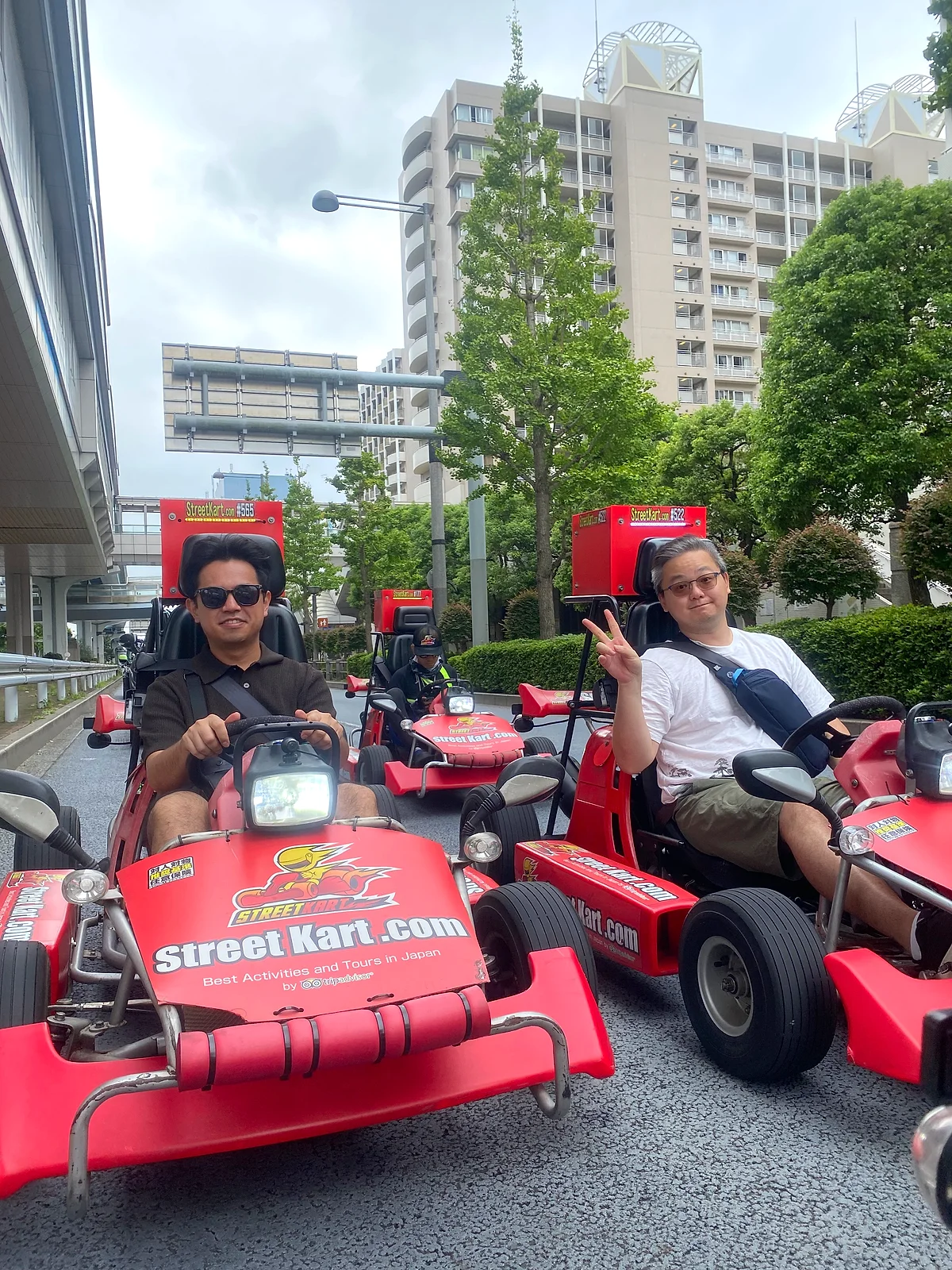
Street Karting in Tokyo with Friends of Every Age and Fitness Level: What to Bring and Wear, Based on the Changing Scenery
The light turns green. You come out of a long straight road through the warehouse district, Tokyo Bay opens up at the edge of your vision, and a sea breeze slips in at your collar. The air feels nothing like it did by the station where you were walking a few minutes ago.
What should you wear for street karting in Tokyo? If you only check the weather forecast, you'll get it about half right. The other half depends on the scenery you'll be driving through. There are open roads with views of the sea, shaded streets between tall buildings, and an electric town with signs stacked overhead. Each time the scenery changes, so does the way the wind hits you and the way the sunlight reaches you.
This article is for people joining Street Kart in Tokyo with a group whose ages and fitness levels vary. We'll follow the scenery along the way and think through what to bring and what to wear as we go.
Why Plan Your Outfit Around the Scenery?
First, one thing about the kart itself. It has no roof and no windows, and the seat sits very close to the ground. The city's wind, sound, and sunlight reach your body almost directly. It feels less like riding in a vehicle and more like moving through the city while sitting down.
So when the scenery changes, what your body feels changes too. Open bayside roads have little to block the wind, so it comes straight at you. On streets lined with tall buildings, you pass in and out of shade. Along tree-lined avenues, sunlight filters through the leaves and the glare softens a little. Over the course of one tour, the way things feel keeps shifting.
When we go out by car, we tend to dress assuming the car will have air conditioning. If you're karting through a Japanese city, set that assumption aside for now.
The trick is to be ready for both the windiest moment and the brightest moment. If you plan for only one, someone will end up putting up with discomfort at some point. That's even more true if your group includes older members or someone who gets cold easily.
Each Location Has Its Own Scenery, and an Extra Layer to Match
Street Kart in Tokyo has a set course for each location, and every tour is led by a guide.
That means the location you choose gives you a good idea of what kind of scenery you'll see. Below, we look at how to prepare for each type of scenery, based on landmarks confirmed along the routes. The order you pass them in, and whether it's light or dark out, varies by tour. Please check the details when you book.
Tokyo Bay and Shinagawa: Open Sea Views Call for Protecting Your Neck and Eyes
Shin-Kiba, home to the Tokyo Bay location, is a bayside area with the sea, warehouses, and new buildings side by side. Along the route you'll see the Rainbow Bridge, which spans Tokyo Bay over a length of 798 m, and Tokyo Tower, completed in 1958 at 333 m tall. The Shinagawa route also offers views of the Rainbow Bridge from the Shinagawa side, the Shibaura, Tamachi area with its office buildings and waterfront scenery, and Tokyo Tower in the distance.
The Tokyo Bay course passes the Rainbow Bridge and Tokyo Tower on its way to the Odaiba area. This waterfront district is lined with large buildings such as the Fuji TV headquarters, and the wide-open bayside sky continues here as well. The Shinagawa route also includes the Takanawa area, home to Sengaku-ji Temple. It's a quiet neighborhood dotted with historic temples and embassies, and the atmosphere is different from the waterfront.
By the sea, the most useful item is a jacket that closes at the neck. If it has a zipper and a collar you can turn up, adjusting takes just a few seconds. Long, loose items like scarves and stoles tend to get caught by the wind while you drive. A neck warmer that fits close to your neck is probably easier to deal with.
The other thing is your eyes. In open areas, glare off the water and white buildings can be brighter than you'd expect. If you bring sunglasses, choose a pair that fits your face securely instead of one you'd push up on your head. Helmets and goggles are provided free of charge at the location. If you wear glasses or sunglasses, try them on with the goggles at check-in before departure so you can set off without worrying about it.
At night, the Rainbow Bridge is lit up in seven colors. The Tokyo Bay course has evening time slots, which are said to offer night views. Check the departure times on the official website. If there's a chance you'll be driving along the bay at night, bring a jacket one level warmer.
Akihabara 1 and 2: Red Brick, Electric Town Signs, and the Shadows of Buildings
On the routes from the two Akihabara locations, the scenery varies much more. You'll see the red-brick Marunouchi Building of Tokyo Station, which opened in 1914 and finished restoration work in 2012; the Ginza 4-chome intersection, home to the Wako clock tower; and Akihabara's electric town, where signs for electronics retailers and anime shops overlap one another. You go from architecture more than 100 years old to streets full of colorful signs. Within a single tour, the face of the city changes several times.
With this kind of scenery, watch out for the shadows of buildings. The main streets have many tall buildings, and the moment you go from sun into shade, it can suddenly feel cooler. Rather than betting on a single short-sleeved shirt, bring an extra thin long-sleeved layer. You'll feel more at ease.
I understand the urge to just tie your jacket around your waist when you get warm and take it off. But if it comes loose while you're driving, it's a hassle. Decide whether you'll wear it or not before you get in, and don't keep anything extra on you. That's all it takes.
Shibuya and Shibuya Annex: From the Buzz of the Crossing to Sunlight Through the Zelkova Trees
Shibuya and Shibuya Annex are two locations in almost the same spot. Along the route you'll see the world-famous Shibuya Scramble Crossing, Harajuku with its Takeshita Street, and Omotesando, lined with zelkova trees. You go from a crossing where waves of people surge past to an avenue where sunlight flickers through the leaves. It's all in the same part of Shibuya, yet the atmosphere feels completely different.
The tree-lined avenue softens the sunlight, so depending on the season, the shade can feel chilly. Omotesando is also known for its winter illuminations. If you're joining in the colder months, bringing gloves is one option.
Your hands on the steering wheel take more wind than you might think. Rather than thick ski gloves, choose ones that let your fingers move easily and don't slip. As your hands go numb, you slowly lose the ability to enjoy the scenery too.
How to Prepare with Companions of Different Ages and Fitness Levels
When you travel in a group, not everyone can always keep the same pace. Some people are full of energy from the morning, while others are still tired from a long trip the day before. So don't build your plan on the assumption that everyone will drive. That's the starting point.
First, eligibility. Street Kart karts are single-seaters, and you can't ride as a passenger. There are also requirements such as a driver's license. For age limits and which licenses are accepted, it's more reliable for each person to check the official website than for this article to give a definitive answer. License rules differ by country. If you check for everyone while planning your trip, you can avoid finding out on the day that someone can't drive.
You'll also want to talk about health before you go. The karts have no suspension, so every bump in the road comes straight through. For this reason, pregnant people are advised not to take part and are asked to consult a doctor. There are no weight or height limits. However, because the engines are small, larger drivers may go a bit slower. If anyone in your group has concerns about their lower back or back, share this information in advance so they can decide for themselves whether to drive or sit it out.
Next, plan how non-drivers will spend their time. If someone won't be driving, choosing a meeting spot near the location makes the day go much more smoothly.
From the Shinagawa location, Shinagawa Shrine is about a 5-minute walk away, and Starbucks Shinagawa Grand Commons is also about 5 minutes on foot. Near the Akihabara locations, Kanda Myojin Shrine is about a 10-minute walk. Around Shibuya and Shibuya Annex, Shibuya Hikarie, about 10 minutes on foot, makes a good landmark. For Tokyo Bay, the café and restaurant CASICA is at the nearest station, Shin-Kiba. None of these are on the tour routes; they're places to stop before or after the experience. Pick somewhere the people waiting can walk to comfortably.
Each location has restrooms. Have everyone stop by once before you set off. In groups with older members, small arrangements like this make the day more relaxed.
The schedule and duration on the day vary by tour. If someone finds it hard to sit for long periods or gets cold easily, it helps to ask about it when booking.
For clothing, there's just one rule: everyone should bring one extra layer, based on the person in the group who gets cold most easily. That alone greatly reduces the chances of someone silently putting up with the cold partway through.
A word about language as well. Guidance on the day of the tour is basically in English. If someone in your group isn't comfortable with English, reach out in advance through the contact options on the official website. Guidance in Japanese or other languages depends on the staff that day and isn't guaranteed. The website is available in 22 languages, but that refers to the site itself, not to the guidance on the day of the tour.
What to Prepare Before You Go, and a Final Check
There's one thing you absolutely must not forget: the original copy of your driver's license. Digital licenses aren't accepted, and without the original you can't take part and won't get a refund. You'll also need your passport and your booking confirmation email or number, and depending on your license type, you may need additional documents. Check the official website for details.
Beyond that, travel as close to empty-handed as you can. While you drive, both hands stay on the wheel. Keep your belongings, including your smartphone, to what fits in a zippered pocket, so you won't need to touch anything while driving. Take your photos slowly before you get in and after you get out. The locations have lockers for small items, but they aren't meant for large luggage like suitcases. If there's something you really need to bring along, pack it in a small bag that can go on the kart.
For shoes, wear closed-toe footwear. Sneakers are recommended, and sandals and heels should be avoided. For clothing, comfortable casual wear like jeans works well; skirts, dresses, and expensive clothes you'd hate to get dirty are best avoided. If you have long hair, bring a hair tie so it doesn't blow around in the wind. Since you'll be wearing a helmet, a low ponytail is probably more comfortable than a high one. With no roof, the sun shines straight down on you, so applying sunscreen in summer is a good idea. A hat comes in handy for walking around the city after you take off the helmet. Check the official website for the latest guidance on clothing and rainy weather. The tips here are only my personal suggestions; in the end, the FAQ comes first.
A little about rain, too. In light to moderate rain, tours go ahead as planned, and raincoats are provided free of charge. Tours are canceled in heavy rain or typhoons, and you can choose between switching to a shorter tour, rescheduling, or a full refund. On days when the forecast is uncertain, you'll feel better choosing clothes that dry quickly even under a raincoat and shoes you don't mind getting wet.
Bookings are accepted via Facebook, LINE, and email, and the contact details for each are listed on the official website. Weekends tend to fill up, so it's best to get in touch early once your itinerary is set. Check the departure slots and the schedule for the day when you book as well.
Whenever friends from my home country visit Tokyo, there's something we always check together the night before: what kind of scenery we'll be driving through tomorrow. Sea breeze, building shadows, or sunlight through the trees? Once you know that, you'll spend a lot less time standing in front of the closet trying to decide.
For the latest information and booking contacts, visit the Street Kart official website. Start by choosing a location, and with it, the scenery you'll drive through.
This article was originally written in Japanese and translated using AI. Some expressions may read unnaturally, and we appreciate your understanding. For the most accurate and up-to-date information, please refer to the official site at kart.st.
Street Kart is not affiliated with Nintendo or the Mario Kart series in any way. We do not provide costumes of Nintendo characters, and such costumes may not be worn during tours even if brought by participants.