
When Should You Visit Tokyo? Planning a Multi-Generational Trip Around the Most Comfortable Mornings, Afternoons, Evenings, and Nights
When Should You Visit Tokyo? Planning a Multi-Generational Trip Around the Most Comfortable Mornings, Afternoons, Evenings, and Nights
Most people start planning a Tokyo trip by picking a month. Cherry blossoms in spring, or autumn leaves in fall? But if your group spans different ages and energy levels, there's another question worth asking. In a given month, what time of day can everyone actually enjoy being outside? Even in August, a park in the early morning and a busy intersection in mid-afternoon feel like two different cities.
Choosing when to travel means thinking about the month and the time of day together. If you're traveling with parents in their 70s and siblings in their 20s with energy to burn, how long everyone can stay outdoors shapes the whole trip. In a month when only mornings and evenings are comfortable, you plan on spending the middle of the day indoors. In a month when you can walk all day, the bigger risk is cramming in too much. The month you pick changes how you build every day.
Honestly, Tokyo's weather varies a lot from year to year, so no month is a sure thing. Instead of giving you one answer, this article walks through how to think about timing, one part of the day at a time.
As the Seasons Change, So Do the Best Hours to Be Out
The simplest way to think about Tokyo's seasons is in three groups: summer, winter, and spring and autumn in between. What matters is that each season has its own "usable" hours. In some seasons the mornings are lovely. In others, it's only warm around midday.
Plan around the person in your group who feels the heat or cold the most. Find the hours when that person can comfortably be outside, and the rest of the trip starts to take shape from there.
Summer Through September: Skip Midday and Plan Around Mornings and Evenings
Tokyo summers are hot and humid. If you're used to dry heat, the moment you step out of the station and your glasses fog up, you may be surprised by how thick and clingy the air feels. This is the season when the Japanese word netchūshō (heatstroke) is on the news almost every day.
Watch out for years when the heat hangs on well into September. If you assume "September is autumn" and plan around that, you may end up walking under sun that feels just like midsummer. For trips from summer into early autumn, the practical approach is to schedule outdoor plans for mornings and evenings, and spend the middle of the day indoors at museums or shopping centers. If older family members are coming along, build a midday break back at the hotel into the plan from the start. That way everyone still has energy for the evening.
You can also be smart about how you get around. Routing through station concourses, underground shopping arcades, and commercial buildings cuts down your time in the sun even over the same distance. Bring hats and drinks for everyone, and remind each other to take a few sips at every break.
Summer mornings in Tokyo have more going on than you might expect. Shutters rattle up along shopping streets before opening time, and in the parks you'll see groups doing rajio taisō (radio calisthenics) and people out walking their dogs. Before the sun climbs, the air still holds a little of the night's coolness. If your parents are early risers, this could be the best part of the trip.
Also note that June or so is tsuyu (the rainy season), and late summer into autumn is typhoon season. Leaving room to shuffle plans around the weather forecast makes the whole trip feel more relaxed.
Winter: Shorter Days Mean the City Lights Come On Early
From December to February, Tokyo has many clear, dry days. In the midday sun, a coat can feel a bit too warm. But once the sun starts to set, it gets cold fast, and along the waterfront the wind off the bay bites at your cheeks.
The interesting thing about winter is how early the sun sets. The city lights start coming on in the early evening, so you can see Tokyo lit up at night without staying out late. That's a real plus for groups with parents who like an early night. The zelkova-lined avenue in Omotesando is a well-known photo spot for illuminations around Christmas, and you can stroll under the lights even before dinner.
In exchange, be ready for the cold after dark. Layers you can easily put on and take off are the way to go. If you stay out into the night dressed for the midday warmth, older members of the group will feel it most.
Winter mornings also call for care, but for the opposite reason from summer afternoons. Even if your parents are early risers, they'll be more comfortable heading out after the sun is up and the air has warmed a little than in the bitter cold of early morning. A winter day works well like this: start the morning slowly, do your walking during the warm middle of the day, and finish with the early city lights.
Spring and Autumn: More Time Outside, but More People Too
During cherry blossom season, from late March to early April, and in the deeper autumn around November, there are more days when you can comfortably spend all day outside. Because time of day matters less, it's easier to plan for a group with mixed energy levels.
That said, spring brings big temperature swings (kandansa) between morning, night, and midday, and some days are very windy. You might walk around in short sleeves at noon and reach for a jacket by evening. And the pleasant seasons attract more travelers too. Popular spots get crowded, especially on weekends, and if you don't book experiences that need a reservation early, you may not get the date you want.
Cherry blossom timing shifts from year to year, and the forecast for peak bloom sometimes firms up only right before you leave. Rather than locking your dates to the blossoms, give yourself a few days of leeway on either side, so it stings less if you miss them. In autumn the days gradually get shorter, so if you're planning an evening walk, check the sunset time the day before.
In the seasons when you can spend the most time outside, the key factors are less about time of day and more about the day of the week and when you book. Keep that in mind and planning gets a lot easier.
Adding a Street Kart Tour: How Does the Scenery Change by Time of Day?
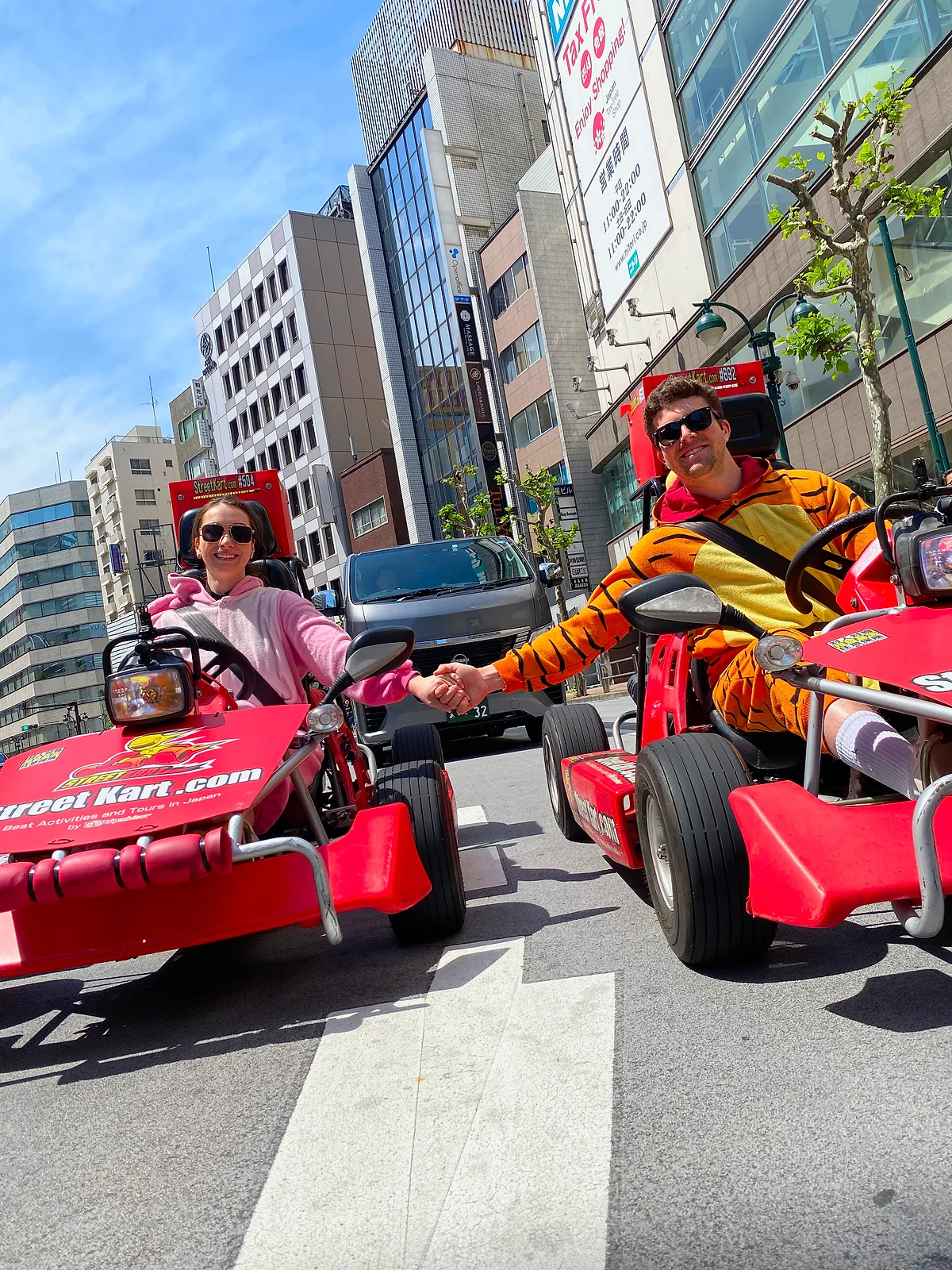
On a multi-generational Tokyo trip, a street kart tour can be a highlight for the members of the group who are able to drive. Street Kart tours follow a guide along a set route that depends on the store. Because each store's route is fixed, the same streets show a different side of Tokyo depending on the time of day. That's part of what makes it fun.
During the day, on the Tokyo Bay store's route, the Rainbow Bridge spanning Tokyo Bay stands out sharply against the sea and sky, with the red-and-white Tokyo Tower beyond it. On the Akihabara store's route, you'll see the red-brick Marunouchi building of Tokyo Station and the Wako clock tower at the Ginza 4-chome intersection. Daylight suits people who want to take in the colors and textures of buildings.
After sunset, the scenery takes on a completely different feel. The Rainbow Bridge is lit up at night, and Shibuya Scramble Crossing, on the Shibuya store's route, glows under the lights of the surrounding buildings with an energy you don't see during the day. Now think back to the seasons. In winter, this nighttime scenery starts in the early evening. In summer, you'll have to wait a bit later to see the same view.
The combination of season and time of day also affects how the ride feels physically. Since you're driving on public roads, you feel the season directly. On a summer midday, it's the heat bouncing off the asphalt. On a winter night, it's the cold wind off the bay. If the driver handles heat well, a summer evening works. If they don't mind the cold, try the winter night views. Picking a time slot that suits the drivers is an important decision too.
Plan your clothing around the season and time of day as well. Closed-toe shoes and clothes that are easy to move in are recommended, and you should avoid open-toed shoes, heels, and skirts. In summer, bring a hat, sunglasses, and sunscreen. In other seasons, bring a jacket suited to the temperature. As for weather, tours go ahead as planned in light to moderate rain, and raincoats are provided free of charge. Tours are canceled in heavy rain or typhoons. On the day, there's check-in and a safety briefing, so you need to arrive at the store before your departure time. Check your booking information for how early to arrive.
Which time slots are available may vary by store and season, so I can't say for certain here. Once you've chosen a season, check the official website for the time slots available then, and compare them with what time of day you want to see Tokyo. Since the tour follows a guide on a set route, it's best to schedule places you want to explore slowly on foot before or after the tour.
Where Do Non-Drivers Spend That Time?
Karts are single-seaters, and passengers aren't allowed. Whether someone can drive depends on age, a driver's license, and other requirements, so check in advance who can take part. For license types and how International Driving Permits are handled, see the official driver's license page. If you don't have the required original license with you on the day, you won't be able to join.
That means you'll also want to think about what non-drivers will do in the meantime, along with the time of day. There are places near each store to visit before or after the tour, or while you wait.
Near the Akihabara store, Ueno Park is about five minutes away by train, with Ueno Zoo, the Tokyo National Museum, and the National Museum of Western Art all close together. Even during hours when walking outside is tough, like a summer afternoon, you can relax indoors at a museum. About a 10-minute walk away is Kanda Myojin, a shrine with 1,300 years of history, known as the guardian shrine of old Edo. Personally, I like visiting in the morning while it's still quiet. On a rainy day, another option is to hop between indoor shops in the electronics district right next to the store, such as Radio Kaikan and Yodobashi Camera.
Near the Shinagawa store, Shinagawa Shrine, about a five-minute walk away, is a nearby option. However, it has stone steps, so it may be a bit of a struggle for anyone with weak legs or knees. About a 20-minute walk away, Tennozu Isle is an area with cafés and galleries along the canals. It's a nice place to unwind by the water in the evening.
Near the Shibuya store and Shibuya Annex, Shibuya Scramble Square, about a 10-minute walk away, has the Shibuya Sky observation deck, where you can look down on the city at dusk. Meiji Jingu, about a 20-minute walk away, is surrounded by a forest so deep it's hard to believe you're in central Tokyo, and stepping into the shade of the trees brings some relief even on a hot day.
Near the Tokyo Bay store, Toyosu Market, about 10 minutes away by car, is busiest from early morning through the late morning. If your parents are early risers, it's a good fit for that time of day. Kasai Rinkai Park, about 15 minutes away by car, has a giant Ferris wheel and an aquarium, giving you more options while you wait. Note that the stores have no parking, so please take public transportation.
Since the tour ends back at the store, making the store your meeting point makes it easy to regroup with members who spent the time elsewhere. Also, the store lockers are meant for small items and won't fit large luggage like suitcases. If you book a tour on the day you check out of your hotel, plan to drop off your bags somewhere first.
What Makes Street Kart Appealing
Let's step away from time of day for a moment and sum up what makes Street Kart itself stand out.
First, there's the feeling you only get in a kart. The wind rushing between buildings, the chime of crosswalk signals, the hum of the city. As you drive, Tokyo's sounds and air feel right there with you. You'll probably keep thinking about it for a while after the ride.
Second, there are seven stores in Tokyo. However, the two Akihabara stores and the two Shibuya stores are each in nearly the same spot, so they aren't spread across seven separate neighborhoods.
Third, the website is available in 22 languages.
Fourth, there's the track record. As of November 2023, Street Kart had run more than 150,000 tours, received more than 20,000 reviews, and held an average rating of 4.9 out of 5.
Things to Check Along With Your Time Slot Before Booking
Finally, once your season and time of day are mostly settled, here are three things to check.
The first is the day of the week. Weekends book up quickly, so if you want to go on a weekend, booking early is recommended. If your itinerary has some flexibility, consider weekdays too. Check the official website for how and where to book. You can also look up each store's location on the site and choose one based on where your hotel is. Before booking, it's a good idea to open the site and go over the requirements and important notes together as a family.
The second is language. Tour guidance on the day is generally in English. Guidance in Japanese or other languages depends on the staff that day and isn't guaranteed. If anyone in your group is unsure about English, contacting the support team through the official website in advance can put your mind at ease.
The third is weather. If you're traveling during the rainy season or typhoon season, knowing the cancellation terms makes planning easier. Cancellations up to seven days in advance are free, but check the official website for the details.
Here's the order for deciding when to go. First, figure out which season gives everyone the longest stretch of time they can comfortably spend outside. Next, decide what you want to see at which time of day in that season. Finally, fit the drivers' tour and the non-drivers' plans around those hours. Working backward from time of day, rather than starting with the month, gets you closer to a trip that doesn't push anyone past their limits.
For example, if you're staying near Shibuya in August, the whole group could walk through the Meiji Jingu forest in the morning, then rest at the hotel at midday. If an evening slot is available, the drivers head out on the tour while the parents watch the city fade into dusk from Shibuya Sky, and then everyone meets up at the store and goes to dinner. Writing out each day by time of day like this shows you, before you leave, who might end up overdoing it and where.
Once you can see which hours are comfortable for being outside, choosing a month often turns out to be surprisingly easy. Do you want to make the most of your parents' energetic mornings? Or do you want everyone together for the moment the city lights come on in the evening?
Once you've picked the time of day you want to see Tokyo, check the time slots available in that season on the Street Kart official website. That's usually what settles the shape of your trip.
This article was originally written in Japanese and translated using AI. Some expressions may read unnaturally, and we appreciate your understanding. For the most accurate and up-to-date information, please refer to the official site at kart.st.
Street Kart is not affiliated with Nintendo or the Mario Kart series in any way. We do not provide costumes of Nintendo characters, and such costumes may not be worn during tours even if brought by participants.